Jantar Mantar Road, Janpath, Connaught Place, New Delhi, Delhi, India
Jantar Mantar Protest Site
Explurge-Ins
5
Ratings (185)
4.4
Distance
-
Jantar Mantar Protest Site
What is this place?
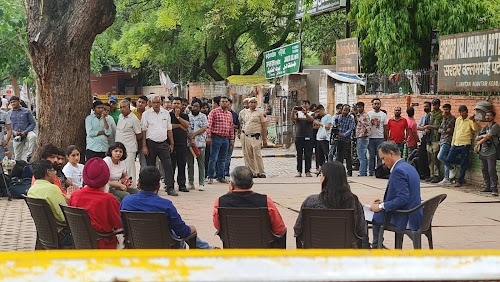
Historical Observatory and Protest Hub – This site is primarily known as the Jantar Mantar observatory, an astronomical instrument complex built in the 18th century. Over time, it has also become a prominent location for protests and demonstrations in New Delhi , reflecting its dual identity as a historical landmark and a space for public expression.
Why people come here
Historical Significance and Public Voice – People visit for two main reasons. Many come to explore the ancient astronomical instruments and understand their historical and scientific importance. Others gather here to participate in or observe peaceful protests, rallies, and demonstrations, making it a significant site for expressing public opinion.
What to expect
Educational and Activist Atmosphere – I find that the atmosphere here can be quite varied. During certain times, it's a relatively calm historical site where you can learn about ancient astronomy. At other times, especially during protests, it transforms into a bustling, vocal space filled with activists, media, and security personnel. The crowd levels can range from moderate tourists to large gatherings, depending on any ongoing events.
Best time to go
Mornings or Weekdays – For a more serene experience focused on the observatory, I recommend visiting during the morning hours on a weekday. If you are interested in observing protests, these typically occur during daytime hours, but their frequency and scale can vary.
Practical info
Timings and Accessibility – The observatory generally has specific visiting hours, often from sunrise to sunset. Entry fees may apply for the observatory section. The site is relatively accessible, located in central Delhi . Parking can be challenging due to its central location and potential for large gatherings. Restrooms and basic amenities are usually available.
Good to know
Dual Identity – It's important to recognize the dual nature of this site. While it's a fascinating historical observatory, its role as a protest venue means that its ambiance can shift dramatically. I suggest checking local news or event listings if you wish to avoid or specifically witness a protest. The astronomical instruments themselves are quite impressive, showcasing ancient Indian scientific advancements.
Historical background
Maharaja Jai Singh II's Vision – This Jantar Mantar was built in 1724 by Maharaja Jai Singh II of Jaipur, who constructed five such observatories across India. Its purpose was to compile astronomical tables and predict the times and movements of the sun, moon, and planets. The instruments here are fixed and massive, designed for accurate measurements without telescopes.
Key highlights
Giant Sundials and Astronomical Instruments – The main attractions are the large masonry instruments, including the Samrat Yantra (a giant sundial), the Jai Prakash Yantra, and the Misra Yantra. These structures are designed to measure time, track celestial bodies, and determine planetary positions. I find the sheer scale and ingenuity of these ancient instruments to be quite remarkable.
How much time to spend
1 to 2 hours – I find that an average visit to explore the observatory and understand its instruments typically takes about 1 to 2 hours. If there are protests or events, you might spend more time observing them.